History
Our Story So Far
Our Lady of The Immaculate Conception Cathedral Guyana has long served as a welcoming place of prayer, worship, and community in Georgetown. This page honors the cathedral’s continuing role in the spiritual life of parishioners, visitors, and the wider community.
Through Mass, sacraments, prayer, and pastoral care, the cathedral remains a visible sign of faith and fellowship. As additional historical records, milestones, and archival details are confirmed, they will be shared here to tell the story of the cathedral with care and accuracy.
In 1824 a group of persons approached the government to provide the Catholics of the then Colony with a place to construct a church.
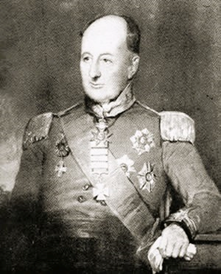
The Governor, Sir Benjamin Durban decided to give a plot of land on Brickdam (the first street to be laid out in Georgetown) for the building of a priests house and a church.
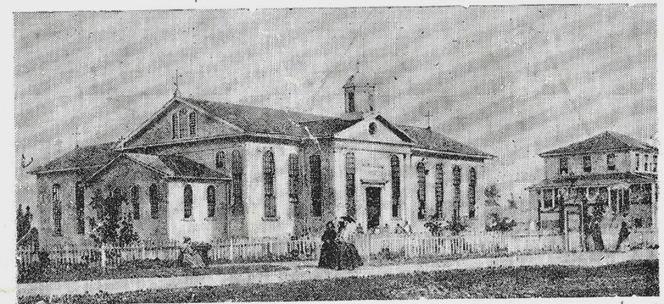
The Bishop at the time was Rev. John Hynes OP. There were four other priests who also worked throughout the entire colony. With the land handed over, a committee was formed to look after construction work. Around the middle of 1825 the church was opened. First named Christ Church, the dedication was later changed to the Church of the Resurrection.
The Church of the Resurrection on Brickdam. In 1857 the first three Jesuit Priests arrived in the Colony as a replacement to Bishop Hynes and his four priests. They began their work. In November of that same year six other Jesuit Priests arrived. The increase in the Catholic population was of concern to the new priests. The Church of the Resurrection was becoming too small in addition the wood work was also deteriorating and a decision had to be made on how to accommodate the growing number of Catholics. One of the first four Jesuit Priests, Fr. James Etheridge was appointed Bishop in succession to Bishop Hynes. In 1867 work proceeded on the demolition of this church. The eastern extension of the church was the Lady Chapel and this was transported to Victoria on the East Coast of Demerara to become the start of the church building there.
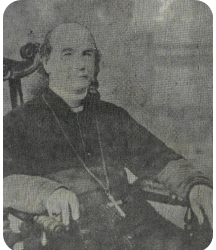
Bishop James Etheridge had been busy since becoming Bishop in part he was called upon to be the Administrator of the Diocese in Trinidad as well as acting as the Apostolic Nuncio, never the less he was concerned with the building of a Cathedral. The foundation stone was laid on the 21st of April 1868 by the Governor Sir Francis Hincks. At the ceremony the Governor gave a donation of $500.00 The Cathedral was to be built with Greenheart and Crabwood. In 1870 another fundraiser was held, a Bazaar at the Assembly Rooms (where the Bank of Guyana now stands) the amount raised was over $3,000.00
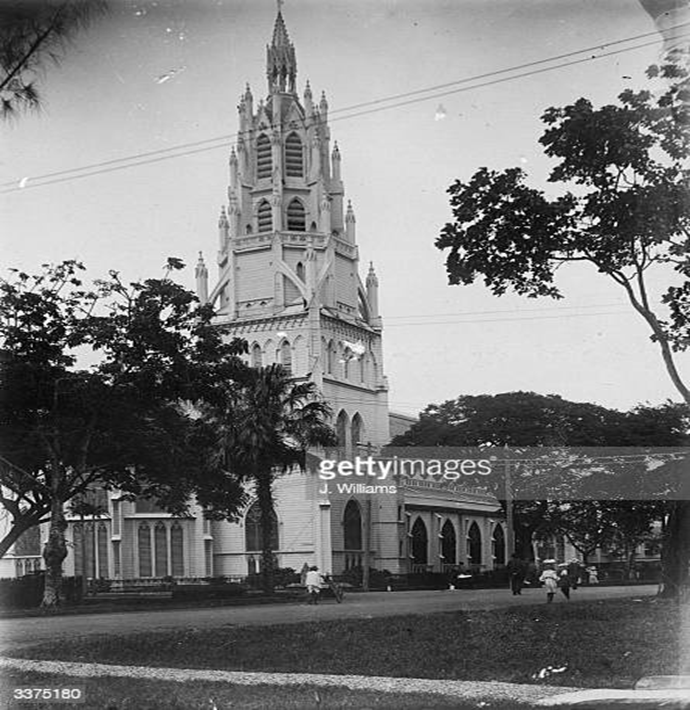
On the 13th of April 1871 the nave and aisles were brought into use, then on the 30th of August 1874 the whole building was opened – The Cathedral of the Immaculate Conception. The length was 160 feet, the ceiling over the nave was 60 feet high and the aisles were 30 feet. The building was described as one of the finest ecclesiastical buildings in the West Indies; the design was the work of Brother Caesar Castellani S.J. and Fr. Ignatius Scoles S.J. The tower was 160 feet high, the top was tapered off into a shrine topped off by a cross this housed a metal statue of Our Lady of Grace. Fr. Scoles had asked all the ladies named Mary to contribute to this statue and all the Josephs to contribute to the shrine.
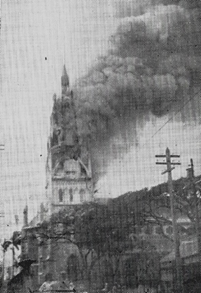
On Friday the 7th of March 1913 a workman was carrying out repairs to drainage pipes near the top of the tower when he knocked over some coals he was using in which to melt lead for the repairs, He thought he had picked up the coals but somehow a piece was left hidden. He came down the tower to get some materials and while he was out in the town, the fire started.
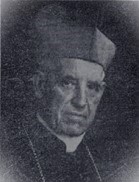
Bishop Compton Galton was being driven up Brickdam when someone called to him telling him that the Cathedral was on fire. He immediately returned, while many persons started to save furniture and other items from the building. Owing to a lack of water the fire spread to the whole cathedral including the priests house. Hundreds had gathered at the scene offering their sympathy to Bishop Galton, but as the fire raged on the Bishop declared that he would rebuild the cathedral and then proceeded to start collecting funds for the rebuilding.
Bishop Galton continued his efforts at raising funds to rebuild the cathedral, appealing to a wide cross section of the community, as his appeal began to bear fruit. The Mayor of Georgetown, Mr. Francis Dias held a public meeting at the Town Hall where almost $12,000 was raised. A building Committee was formed, the leading member on the committee was Sir Joseph Nunan; he was the Attorney General of the Colony. Permission was given to import the cement and steel needed for construction free of duty.
It is important to note that after the Cathedral fire all Masses were held in St. Mary’s R.C. School which was across from the Cathedral site. This helped in large measure to facilitate Catholics as the only other church in Georgetown was Sacred Heart which at the time was a smaller church building. Another development that occurred was a request from the authorities for a portion of land at the eastern end of the Cathedral site to be given up; this was to allow for Camp Street to run straight so as to make for easier road travel as against the way the road had been laid out around the Cathedral.
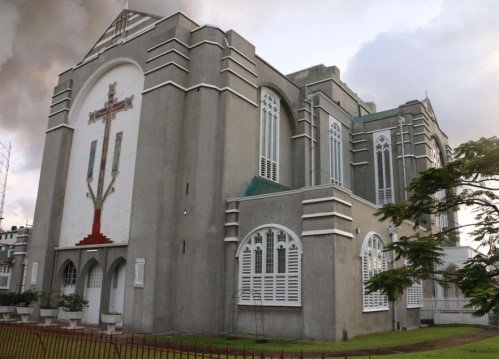
In the West Indies at the time was Sir Leonard Stokes, president of the Royal Institute of British Architects. Bishop Galton requested him to come to British Guiana to advise on a suitable design for the new Cathedral. On the advice of Sir Leonard it was decided that the Cathedral was to be made in ferro-concrete of an early Gothic of the XII century, the contract for the building was given to the Considere Construction Company of England with experience in ferro-concrete construction; the Clerk of Works (from England) was Mr. Alexander Walker.
The stone used was granite which was got from the quarries at Dalli and Wolga in the Essequibo, the sand was from the island of Leguan. The building was to be 200 feet long and 100 feet wide, the center ceiling 60 feet 6 inches and the dome 74 feet 10 inches. The outer walls being 80 feet in height. The estimated cost was $200,000. Owing to a lack of funds the tower and spire were never added. The foundation stone was laid on the 15th of August 1915.
The western half of the building was opened for worship on the 13th of March 1921. On the Sunday after the feast of the Immaculate Conception in December 1925 the whole Cathedral was opened and blessed by Bishop Galton. The crowds that entered the new Cathedral saw for the first time the magnificent stone (lapis laxuli) crucifixion on the eastern wall, the identical scene is also on the exterior of the eastern wall facing Camp Street. The cathedral is bordered by four streets, Camp Street on the east, Pollard Place on the west, Brickdam on the north and Hadfield Street on the south. The steel statue of Our Lady of Grace that fell in the fire of the previous cathedral was placed high above the main entrance of the new cathedral.
The marble high Altar was a gift to Bishop Galton from Pope Pius XI and was installed in 1930. Three side altars were ordered from Italy, the Lady altar in grey stone, the Sacred Heart and St. Joseph altars arrived in 1939 just before the start of the Second World War. Both the Sacred Heart and St. Joseph altars feature beautiful stained glass depictions. Also in marble is the pulpit in memory of the Fogarty family who served in world wars. All debt on the cathedral being cleared, it was consecrated on the 10th of October 1960 by Bishop R.L. Guilly S.J. who was the first Bishop of Georgetown. As a sign of its consecration twelve stone crosses are affixed to the interior walls of the cathedral.

Legacy
A Living Tradition
The cathedral’s history is not only found in dates and buildings, but also in the faithful witness of generations who have gathered here in hope and devotion.
From daily worship to major feast days, the life of the cathedral continues to be shaped by prayer, service, and the shared traditions of the Catholic Church.
This page will grow over time as approved historical content is added, offering parishioners and visitors a fuller picture of the cathedral’s journey in Guyana.